What to Blog About When You Have Nothing to Say

Ask a small business owner why the blog went quiet and the answer is rarely laziness. It is the sense that everything worth saying has been said, and that nobody wants to read a company diary anyway. The second part is true, and it points to the way out: readers never wanted a diary, they want their question answered. You already answer those questions every week by email, by phone, and in DMs. This guide is a five step system for turning them into posts people actually search for, with our own Search Console data as proof that it works.
Every year Orbit Media surveys more than 1,000 content marketers about their blogs. In the 2026 edition, the average post took 3 hours and 20 minutes to write, and only 13.9 percent of respondents said their blog delivers strong results. Those two numbers together explain why so many small business blogs stop after three posts: real effort, invisible payoff.
The usual diagnosis is "we ran out of things to say." It is almost never true. Most business blogs fail at the choosing stage, not the writing stage: they publish what the business wants to announce instead of what a buyer would ever type into a search box. Meanwhile the owner answers genuinely searchable questions all day, by email, on the phone, in Instagram DMs, and none of it ever reaches the website. The five steps below turn that daily answering into a publishing system.
Step 1: Collect ten questions you have already answered
Do not brainstorm. Collect. Brainstorming produces topics you find interesting; your sent folder contains questions real customers paid attention to.
Open your sent email and search for a question mark. Skim the last three months of replies and copy every customer question you answered properly.
Add the questions you answer out loud: what people ask on the phone before they book, and what they ask in person before they buy.
Check your social DMs and any contact form submissions for the same.
Write each one down in the customer's exact words, not your summary of it. "Can you fix water damage or do I need a new phone?" is a post. "Device repair FAQs" is not.
How to check it worked: you have a list of at least ten questions, each phrased the way a real person asked it. Most owners who try this find the first ten in under half an hour.
Step 2: Keep the ones people also search for
A question is worth answering in public when strangers type it too, not just your existing customers. Two quick tests, no paid tools:
The repeat test. If two different customers have asked it, more people are searching it. Repetition is demand.
The autocomplete test. Start typing the question into Google. If autocomplete finishes it, or the result page shows a "People also ask" box with versions of it, people search this phrasing every month.
This is not a theory about how other businesses get found. Here is our own Search Console query report for the last 28 days:
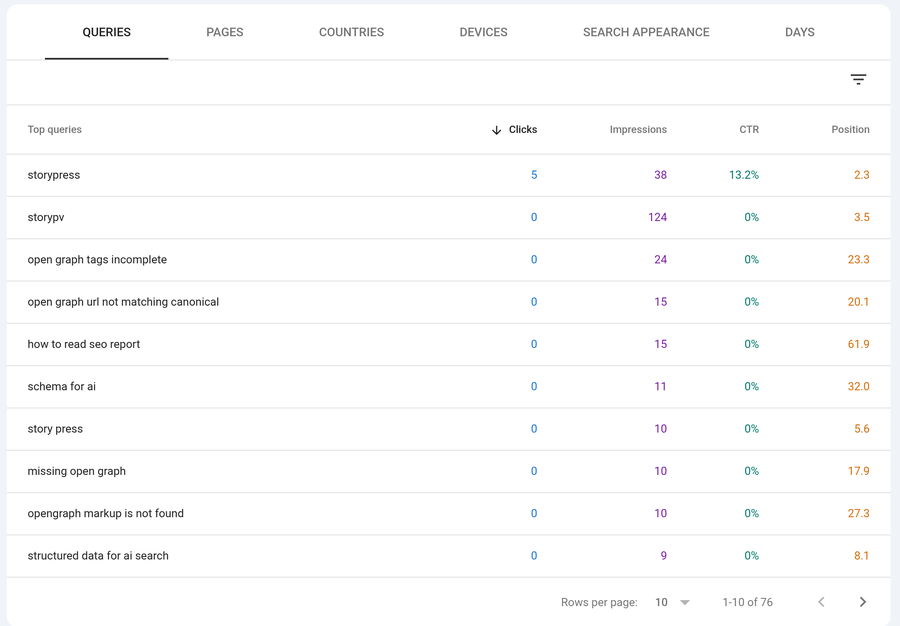
People do not arrive typing polite single keywords. They type whole questions and literal error messages, exactly as the problem presented itself. One post on this blog that answers a single error message was shown 204 times in those 28 days. That is what one well-aimed answer does on a small, young site.
Step 3: Use their wording as the title
The biggest self-inflicted wound in small business blogging is translating a perfectly searchable question into insider language. The customer's phrasing is the keyword research:
| The title a business writes | The question a customer searches |
|---|---|
| Our pottery care philosophy | Can you put handmade pottery in the dishwasher? |
| Spring maintenance reminder | When should I service my AC before summer? |
| A note on our ingredients | Why does sourdough cost more than regular bread? |
| Announcing our new booking system | Do I need a deposit to book a wedding photographer? |
Keep the title under about 60 characters where you can, and resist the urge to be clever. A plain question beats a pun every time someone is searching with a problem in hand.
Step 4: Write it the way you would say it
You have already written this post once, as an email. Keep that register:
Answer first. The real answer goes in the opening paragraph, not after 400 words of wind-up. Readers and search engines both reward pages that resolve the question fast.
Then the detail. The "it depends" cases, the exceptions, the one mistake people make. This is where your experience shows.
Add the thing only you have. A photo you took, your actual prices with the reason behind them, the detail specific to your town. Google's own guidance on helpful content asks whether the page shows first-hand experience. A generic answer can be scraped; yours cannot.
On length: the Orbit survey's average post is 1,312 words, but the average is not a target. A complete 600-word answer outranks a padded 1,500-word one, because readers stay with it.
Step 5: Pick a cadence you can keep, then verify
The same Orbit data shows publishing frequency has fallen for a decade; monthly publishing roughly doubled since 2014 while multiple-posts-per-week collapsed. Fewer, better posts won. For a small business, one real answer a month is twelve answered questions a year, and that beats a heroic burst followed by silence, which search engines read as abandonment.
The publishing step should also be the cheap part. On StoryPress the $5 a month covers the site, and you edit by asking Claude in plain English, so turning Tuesday's emailed answer into Friday's post takes about as long as the email did. No plugin updates between you and publishing.
Then close the loop. Search Console is free: connect your site, wait a few weeks, and open Performance. You are looking for your question appearing in the query list with impressions. That is strangers typing the thing you answered. When a query shows impressions but no clicks, your title is not winning the click, so rewrite it closer to the customer's wording and check again next month.
Do
Answer one question per post, completely
Use the customer's wording as the title
Add the thing only you have: your photos, your numbers, your town
Pick a cadence you can hold for a year, even if that is monthly
Check Search Console once a month for new questions
Don't
Publish company news nobody searches for
Batch ten thin posts in one weekend burst
Pad a complete 600-word answer to hit a word count
Copy a competitor's topic list
Quit at week three because nothing has happened yet. Search takes weeks to respond
“You do not need something to say. You have been saying it, one inbox at a time, all year.”
The 30-minute version
Search sent mail for "?" and list ten real customer questions.
Keep the three that pass the repeat test or the autocomplete test.
Write one answer-first post this week, in the customer's wording, with one photo or number only you have.
Put next month's post on the calendar before you forget the feeling.
Twelve months of that is a website that answers questions while you sleep, built entirely from conversations you were having anyway.

Who Really Owns Your Domain Name?
Most owners can name their web designer, their host, and their website builder, but not the company that actually holds their domain name. That gap stays invisible until a renewal quietly fails or an agency relationship sours, and the address every customer knows suddenly belongs to a process instead of a person. Every domain has an owner, a renewal date, and, from November 1, a higher wholesale price. This guide shows how to check all three in about five minutes with a free ICANN lookup, then set up renewals so they never become an emergency.