5 Homepage Headline Formulas That Convert

Your homepage headline is read five times more than anything else on your site, and most small businesses spend it on the word Welcome. The visitor gives you a few seconds to answer one question: am I in the right place? Quality you can trust and passion for excellence do not answer it; they could hang over any storefront in any industry. Specifics answer it. This guide gives you five headline formulas that survive contact with real customers, each with a before and after from an actual business type, plus a real example page we built and screenshotted so you can see one working.
David Ogilvy worked it out sixty years ago: about five times as many people read your headline as read anything else on the page. Nielsen Norman Group's reading research backs him up, visitors read roughly 20% of the words on a typical page. Your headline is the one line almost everyone actually reads, and it decides in a few seconds whether they scroll or leave.
Yet most small business homepages open with some version of "Welcome to our website" or "Quality service you can trust." Those lines fail a simple test you can run right now:
The competitor swap test
Read your headline and ask: could this exact sentence sit on my closest competitor's homepage without anyone noticing? If yes, it is not a headline, it is wallpaper. A working headline could only describe your business, for your customer. Everything below is about getting you to a line that passes.
The three jobs of a headline
A stranger lands on your homepage knowing nothing. In under ten words, your headline has to answer three questions: what is this, is it for me, and why should I care. Here is one headline doing all three jobs at once:
Notice what is missing: the company name, the word "welcome," and any adjective like "quality" or "passionate." Your name belongs in the logo. The prime real estate goes to the customer's problem.
Five formulas you can fill in today
You do not need to be a copywriter. Each of these is a fill-in-the-blank pattern. Write your business into all five, then keep the one that sounds most like something a customer would say.
| Formula | Template | Filled-in example |
|---|---|---|
| Outcome first | [Result they want] without [their main pain] | A booked-out calendar without chasing referrals |
| How we help | We help [audience] [achieve outcome] | We help Etsy sellers turn browsers into repeat buyers |
| Service + place + promise | [Service] in [place], [differentiator] | Wedding photography in Vermont, delivered in 10 days |
| Question hook | [Pain question]? [Your answer] | Tired of no-show appointments? We fill the gaps automatically |
| Social proof | [Number] of [audience] trust us to [outcome] | 300+ Hudson Valley homeowners heat with us every winter |
One rule across all five: be specific. "Supercharge your business" loses to "Cut your bookkeeping to 2 hours a month" in test after test, because a specific promise is believable and a vague one is noise.
What these formulas look like on a real homepage
Each headline below is applied to a fictional small business. Notice how the formula gives the visitor an immediate reason to keep reading.
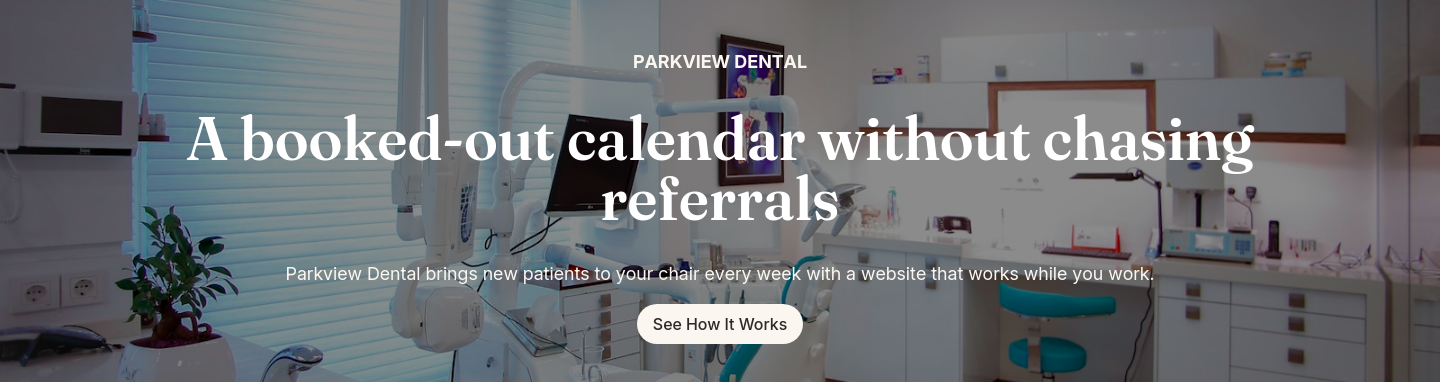



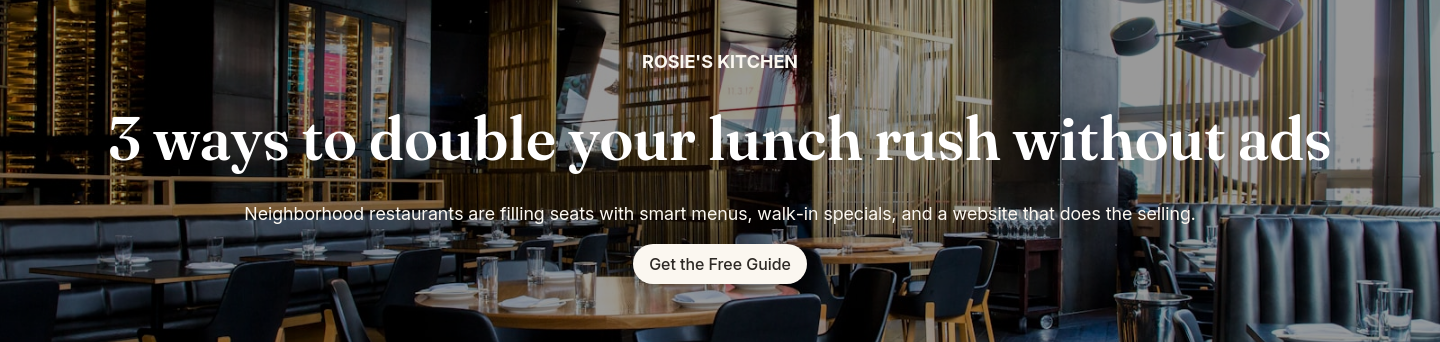
Before and after: three real rewrites
Here is what the swap test plus a formula does to typical small business headlines. Each "before" is the kind of line we see on real sites every week. Each "after" is the same business, made unmistakable.
Before
"Welcome to Riverside Dental" (a greeting, not a reason to stay)
"Quality landscaping services you can trust" (passes on any landscaper's site)
"Your partner in creative solutions" (nobody searches for creative solutions)
After
"Gentle dentistry for nervous patients, evenings and Saturdays included"
"Lawn care on autopilot: one flat monthly price, no contracts"
"Brand design for food trucks and restaurants that need to stand out on the street"
Read the after column and try the swap test on each one. The dentist line only works for a practice that actually offers evening hours. The landscaping line only works with flat pricing. That is the point: a good headline is a commitment, not a decoration.
Write yours in 20 minutes
List the raw material (5 min). Write down: your main service, your customer in one phrase, the outcome they want, their biggest annoyance with your industry, and one thing you do that rivals do not. Use words customers have actually said to you, from reviews, emails, or phone calls.
Fill in all five formulas (5 min). Ten drafts beat one. Bad drafts are fine, they are stepping stones.
Run the swap test (2 min). Kill every draft that could sit on a competitor's site unchanged.
Run the 5-second test (5 min). Show your best draft to someone who does not know your business for five seconds, then hide it and ask: what does this company do, and who is it for? If they can't answer both, sharpen it.
Pair it with a subheadline and one button (3 min). The headline earns attention, the subheadline adds one supporting detail (price, area served, proof), and a single clear button says what to do next. One button, not three.
How to check it worked
Note this week's numbers before you change anything: visitors and enquiries (or bookings, calls, sales). Swap the headline, change nothing else, and compare the next 2 to 4 weeks against that baseline. Small sites will not get statistical significance, and that is fine. You are watching for the direction of enquiries and for people saying "I saw on your site that you do X." That sentence means the headline is being read.
If your headline could sit on a competitor's homepage unchanged, it is not a headline. It is wallpaper.
One last practical note: headline testing only happens if changing the headline is trivial. If editing your site means logging into a clunky dashboard or emailing a developer, you will write one headline and never touch it again. On a site built with StoryPress you can literally tell Claude "swap the homepage headline for this one" and it is done, which makes trying two or three variants over a month painless. Whatever platform you use, remove the friction, because the rewrite you never ship converts nobody.
One practical website fix in your inbox, every week

Sitemaps and Robots.txt: A 5-Minute Check
Two small text files quietly govern how search engines treat your entire site. The sitemap lists every page you want found; robots.txt sets the rules for what crawlers may read. Most owners have never opened either, which is usually fine, until a redesign ships a robots file that blocks the whole site, or a sitemap keeps advertising pages deleted a year ago. Errors here are silent: nothing looks broken to a visitor while your pages fall out of the index. This guide is the five-minute check: where the files live, what healthy ones look like, and the mistakes worth fixing today.

GDPR for Small Business Websites: What You Actually Need
GDPR has a reputation as the law that put a cookie banner on every website in the world, and the fear around it pushes small businesses into consent pop-ups they may not even need. The rules are more forgiving than the panic suggests: what matters is what your site actually collects and where it sends the data, not how big you are or where you are based. A five-page site with a contact form has different duties than a store running ad pixels. This guide sorts it out in three questions, then walks the concrete steps: what needs consent, what needs a privacy page, and what needs nothing.